Touch
A little girl with wide hurt
Eyes and pigtails came out
Of her shadows in Langely
Porter Hospital and
Whispered shyly,
“Tommy, can I touch Al Falfa?”
I nodded.
She touched the farmer
Puppet,
Stroked him gently,
Then quickly hugged him
Tight and wouldn’t let
Him go.
I knew then, the Good Lord
Willing, I would toss all my
Puppets in my shopping bag,
Go out again, and try
To bring another chink
Of light to some other
Little child lost deep
In the shadows.
--Tommy Roberts
I want to thank all of you who shared your memories and photos. It’s taken a few years to gather this material. It all started when I discovered a copy of “I Gotta Hunger, I Gotta Need” in my mother-in-law’s library in Nova Scotia. I saw some photos in that photocopied, hand-assembled book and recalled photos of Tom Roberts taken by Imogen Cunningham, seen in a library book in Charlottetown, PEI. So that is how I started to ask myself, “Who is this guy?” And you all provided essential information to answer that question. Again, thank you.
Nathaniel S. Rounds
Jed Diamond, son of the late Tom Roberts, shared with me his recent article about his father. I have reproduced it with his permission and present it here:
My Father’s Stay at God’s Hotel: A Slow-Medicine Approach to Healing Mental Illness
June 13, 2014 By Jed Diamond
It’s been a long journey to come to peace with my father’s life and how it has impacted my own. I was born on December 21, 1943 in New York City. My parents had tried to conceive for many years, but had been unsuccessful. They finally were successful when my father was 37 and my mother was 35 following a procedure where my father’s sperm was injected into my mother, a radical approach back then.
The vague memories I have of my early life were positive. One that sticks in my mind is a memory of being 3 or 4 sitting on my father’s shoulders, laughing wildly as he rode me around the small park in Encino, California, not far from our house in Sherman Oaks. The San Fernando Valley of Los Angeles was beautiful in those early years of my memory with citrus groves as far as the eye could see.
But other memories were not so positive. I have flashes of my father’s anger, times when he was irritable, angry, and withdrawn, and periods when he would disappear for days at a time. I learned later than he had become increasingly depressed and would have been diagnosed as bipolar, if that diagnosis had existed at the time. He couldn’t find work in his chosen field as an actor, author, and playwright.
When I was five years old, my father tried to take his own life. Although he survived physically our lives were never the same. I grew up wondering what happened to my father and whether it would happen to me. When I became a father I made a vow to my son, Jemal, when I held him moments after his birth. I told him that I would be a different kind of father than my father was able to be for me and I would do everything to create a different kind of world where the wounds of our fathers were healed and children could grow up free of the pain suffered by their parents.
Following the suicide attempt, my father was hospitalized at Camarillo State Mental Hospital. I still remember visiting him with my uncle. It seemed a horrible place with people shrieking madly or zonked out on drugs. My father spent seven years locked up there and I watched him deteriorate and become even more depressed and crazy over the years.
I grew up and our lives moved on. I felt ashamed that my father was in a mental hospital and avoided talking about him. The doctors told my mother that he was a chronic schizophrenic and would never leave the hospital. Back then if you acted “crazy” the general diagnosis was schizophrenia. These days he would have been diagnosed as suffering from bipolar disorder or, on his good days from attention deficit and hyperactivity disorder or Irritable Male Syndrome. Eventually my mother and he divorced.
My father escaped from Camarillo after being there for seven years. He walked more than a hundred miles and took up residence in Santa Monica. An uncle unexpectedly ran into him years later and told me where he was living. I went to see him and was struck by two things. He was, as the song went, “still crazy after all these years.” But he could also be kind and gentle and he put on puppet shows for the children in the neighborhood.
He would seem normal for a while, but then would become agitated and paranoid. His anger would escalate and he would become consumed by it. Eventually he would scream at me, tell me he never wanted to see me again, and threaten me until I would reluctantly leave. He refused to get help for his “mental illness,” which I could understand, given his experiences in Camarillo. I saw him numerous times over the years, but our encounters always ended the same way. I eventually gave up having a father I could trust and moved on with my own life.
The Call From Laguna Honda
I received an unexpected call from a social worker at Laguna Honda Hospital in San Francisco. They told me my father was hospitalized there and I could come and visit him if I wanted. They said he was in good shape now and had been there for three months. I was a bit shocked to hear from anyone about him. I was curious about where he was and how he had ended up there, but I was also reluctant to face the anger that I remembered from the past.
I did visit and I found a man who had changed. His anger seemed to have melted away. The kindness and compassion were more evident. He seemed happy for the first time in his life. “This place has changed me,” he said. “It’s totally different than the concentration camp in Camarillo. These people really care about you.” I didn’t know how it had happened, but I was glad it did.
He eventually left the hospital and moved into a little apartment in the Tenderloin area of San Francisco. We had twenty good years of connection until he died at age 90. It was years later that I came to understand the healing that occurred in God’s Hotel.
God’s Hotel
Victoria Sweet, M.D. spent more than 20 years as a physician at Laguna Honda Hospital. In her recent book, God’s Hotel: A Doctor, A Hospital, and a Pilgrimage to the Heart of Medicine, she describes her journey and the kind of care that was given at Laguna Honda. “San Francisco’s Laguna Honda Hospital is the last almshouse in the country, a descendant of the Hôtel-Dieu (God’s Hotel) that cared for the sick in the Middle Ages,” she says, “Ballet dancers and rock musicians, professors and thieves —anyone who had fallen, or, often, leapt, onto hard times and needed extended medical care — ended up there.” My father was one of the fortunate “creatively crazy” people whose wounds were healed at Laguna Honda.
Dr. Sweet had the chance to practice a kind of “slow medicine” that has almost vanished in our world. Alongside the modern view of the body as a machine to be fixed, her patients evoked an older notion, of the body as a garden to be tended. Fortunately, my father and thousands of others had a chance to be the beneficiaries of the slow medicine that heals body, mind, and soul. In a world of fast food and quick fixes, we need the medicine that Dr. Sweet was able to practice at Laguna Honda. Let the spirit of God’s Hotel live on forever. We all deserve the chance to check in when we are in need.
The following is compiled from a 5/21/07 email response from Robert’s son Jed Diamond, and from there you can read an online bulletin and a letter I sent to the editor of the Daily Planet, and this is followed by email responses and articles. The topic is Tom Roberts (real name Morris Diamond) aka The Puppet Man. Contact me at nsrounds@gmail.com
He was born December 17, 1906 in Jacksonville, Florida (Morris Diamond) and died in San Francisco on April 26,[1996].
In between, he did a lot of living. When I was 6 years old, he tried to commit suicide, the culmination of his wrestling with manic-depressive illness (unknown at the time). He was later hospitalized for many years, and told he would never leave the mental hospital.
We thought that would probably be the case, but he escaped, walked to Los Angeles (120 miles) and began doing his puppet shows (at first, I’m sure, as a way to continue his acting. He was an actor in New York in the 1930s and 1940s. With puppets, he could do a lot of acting without calling attention to himself. This was still at a time when they went after people who escaped from Mental Hospitals and brought them back. He soon was known as Tommy the puppet man).
They never caught him and he continued doing his shows all over California for more than 30 years. There were many people (mostly young women) who would come up to him and remember his shows from when they were little girls. They would often be bringing their own children to listen to Tommy, the puppet man do his show about the spotted dog. “I don’t know whether I’m a white dog with black spots or a black dog with white spots. Why do people have to be so hung up about black and while. Can’t we just love each other?”
I hope I’ve incorporated some of his spirit into my own life and shared it my own writings.
Thanks for asking.
Best wishes,
Jed
Excerpt from Letter to Editor:
Tom Roberts performed a puppet act on the streets of Berkeley. Many students from the early to mid seventies recall him on the Sproul steps and his act his with affection. He would give flowers to young women and quip, “Berkeley is so liberal, I have to pass out two hats!”
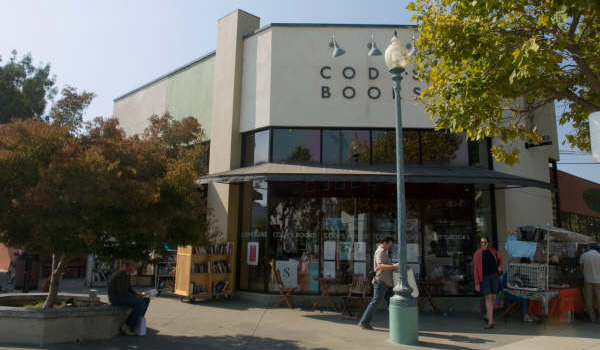
He wrote books of poetry, which were published locally and/or by him. One such title: “I Gotta Hunger-I Gotta Need” by Tom Roberts. Description: Inscribed and signed by Tom Roberts (The Puppet Man), Berkeley local folk artist and puppeteer. 44 pp illustr. soft cover, Cody’s Books, Inc. Berkeley, CA, 1971.
Other books by Tom Roberts—
To Chico With Love, Mosaic Mexicano, and Bridge to Berkeley
Roberts lived at 1010 Bush Street, San Francisco, which is now the Balmoral Residence Club. I called to see if they have always been the BRC but I only got the voicemail. No response as of yet.
This came in from an online bulletin reader:
I met him when I was a patient at Laguna Honda Hospital in San Francisco in about April of 1987. I think he was introduced to me as Tommy Roberts. He gave me a poem. I am fairly certain tha[t] he was a resident of Laguna Honda’s living area known as Clarendon. This was (or is still for all I know) an area for people who were elderly and indigent, bet essentially independent or needing very little assistance.
Here is his Obituary With the Person who Sent it to Me:
Hi Nat,
I just read your letter in the Berkeley Daily Planet. Have you seen this SF Chronicle article from May 26, 1996?
Mike
FAMILY, FRIENDS MARK PASSING OF SAN FRANCISCO PUPPET MAN
Steve Rubenstein, San Francisco Chronicle
The Tenderloin said goodbye to Tommy Roberts, the puppet man, with tears in its eyes and cookies in its mouth.
The puppets were there, sitting on a small table. There was a king, a dog, a scarecrow and a bunch of little men. All were silent, an unusual condition for a Tommy Roberts puppet, which worked harder than any other marionettes marionette: see puppet. In history.
If they could have talked without him, they would have recited the poem about Union Square, or the one about the Mill Valley library, or the one about the dog who didn’t know what color he was.
Over the past 30 years, Roberts had a way of showing up on college campuses and in city parks with paper bags full of ragged homemade hand puppets.
The puppets, only slightly smaller than their 4-foot-8-inch master, would proceed to recite Roberts’ ragged homemade poems, usually without being asked. Crowds would gather, usually small ones.
The puppet man died last month, at the age of 89. He lived in a hotel on Turk Street, the kind with a buzzer on the front door and folks sitting on sofas in the lobby. Recently, the folks regrouped in the TV room for a brief memorial service. A memorial service in a TV room is rare, but that’s the kind of person Tommy Roberts was.
“By the standards of society, my father was not a success,” said his son, Jed Diamond. “He didn’t make a lot of money. He was labelled as mentally ill. He liked to live among people that society pretends do not exist.”
The crowd jammed every seat and spilled out into the hallway. They signed the memorial book – one of the cheap scratch pads that Roberts always carried in his pocket. They snatched up free copies of Roberts’ poems.
“Because of you,” said one, “old madness has become new meaning. Because of you, my tongue is no longer lead."
Tommy Roberts came to California in the 1940s after his New York acting career went the way of many New York acting careers. He wrote radio scripts that never got produced. He lived in sanatoriums and escaped from them.
He left Camarillo, Laguna Honda and St. Francis hospitals on his own terms, usually by slipping out a back door and getting on a bus. He wore a black watch cap and dined on Milky Way’s and Cokes.
Sculptor Ruth Asawa, who made puppets for Roberts, cradled one of them in her arms. Minister Glenda Hope, who preaches on the streets of the Tenderloin, delivered her eulogy in a wildly colorful flower tunic.
“The black jacket didn’t seem appropriate today,” she said.
In the 1960s and 1970s, Roberts was a regular in Sproul Plaza at the University of California at Berkeley.
He and his puppets last appeared at the opening of the New Main Library in San Francisco last month. It took Roberts about two hours to walk the half-mile to the library on his son’s arm.
“Einstein once said that one should strive to be not a man of success but a man of value,” his son said.
Paper cups of bright red punch were raised all around.
“Him and me, we got along good,” said the guy from down the hall. “He was the puppet man.”
COPYRIGHT 1996 Daily News
Copyright 1996, Gale Group. All rights reserved. Gale Group is a Thomson Corporation Company.
Further about Jed Diamond and his Father:
Robert’s son, Jed Diamond, is Director of MenAlive (www.MenAlive.com), a health
center for men and the women who care. A licensed psychotherapist for 35 years, Jed Diamond is an internationally recognized educator in the area of men’s health and empowerment.
Jed is also the author of seven books including the landmark bestseller, “Male Menopause”. The book details the hormonal, physiological, psychological, interpersonal, social, sexual, and spiritual changes that occur in all men between the ages of 40 and 55.
He has also authored, “Surviving Male Menopause: A Guide for Women and Men,” and his latest book, “The Whole Man Program: Reinvigorating Your Body, Mind, and Spirit after 40″. Jed has shared his expertise on the midlife male condition on numerous shows, such as “The View” and “Good Morning America.”
Here is an article about Jed Diamond and his father:
Suffering from manic-depression, Morris Diamond first attempted suicide in 1949 when his son, Jed, was only six-years-old. This traumatic event was an impetus for the boy to one day become an expert in dealing with male depression.
Jed Diamond has been actively involved in men’s work for more than 24 years and written a number of books including Surviving Male Menopause and The Whole Man Program.. The Irritable Male Syndrome will be published next year by Rodale Press.
He is currently on the board of advisors for the Men’s Health Network, on the Scientific Advisory Board of The World Congress, plus he works with The International Society of Aging Males.
He has a Masters degree in social work and is currently working on his Ph.D. in International Health – a new discipline that studies health practices around the world. His dissertation is on male depression.
His father’s story is a troubling and poignant tale of a man who was put in a state mental hospital and treated for schizophrenia, including Electro-shock therapy. Unfortunately, Morris was misdiagnosed. He was manic-depressive.
“After seven years in there, he escaped one night after a visit with my uncle,” Jed recalled. “After that he changed his name and never came back.”
Before this incident, Morris had been a struggling writer and actor in New York City.
“He met my mother and they married on her birthday, October 5, 1934 after a somewhat stormy courtship period,” Jed noted. “When all the money ran out they would invite friends and acquaintances to their small apartment and my father would put on a show with readings from Shakespeare, his own poetry or short stories. The price of admission was a can of food.”
Most of what Jed knew of his father’s early years was derived from reading journal entries. Morris wrote this about his son, Jed:
“He has a wonderful impishness, a beautiful delightful growth about him. He has a suppleness of mind and body, a rapt
t attention as he looks for animals and calls to them.”
Morris described his exalting highs and depressing lows.
“I feel full confidence in my writing ability. I know for certain that someone will buy one of my radio shows. I know for certain that I will get a good part in a play. Last night I dreamt about candy. There was more candy than I could eat. Does it mean I’ll be rewarded for all my efforts?”
Then later he writes:
“Your flesh crawls, your scalp wrinkles when you look around and see good writers, established writers, writers with credits a block long, unable to sell, unable to find work. Yes, it’s enough to make anyone blanch, turn pale and sicken.”
On a Sunday morning in early November Morris was feeling particularly depressed.
“My hope and my life stream are both running desperately low, so low, so stagnant, that I hold my breath in fear, believing that the dark, blank curtain is about to descend.”
Six days later he tried to kill himself. Because of his manic-depressive illness and lack of adequate treatment, Jed said his father was “never able to actualize his potential to flower and flourish.”
Through his sickness, however, his creative juices, continued to flow.
“My father couldn’t go back into the arts [in New York] because people were looking for him after he escaped from what he described as a ‘prison,’” Jed continued. “So he became a street puppeteer in California.
For 40 years he worked putting on puppet shows at gatherings on University campuses.
“He showed up at my college graduation in Santa Barbara,” Jed said. “It was scary to see him out there and then he disappeared like some dramatic film screen moment.”
Jed tried for many years to find his father through his relatives in Florida.
“I was back in the Bay area one day,” Jed recounted. “I’m waiting for a bus in San Francisco to go across the bay to Marin County and as I’m standing there day dreaming, thinking about my visit to Florida, I missed my bus. I waited and got on the next one. As I’m sitting there, my father gets on at the next stop. ”
“You’re the Puppet Man.”
“There he is, I say to myself. My God, that’s him. Should I talk to him.? I’m afraid if I do I’ll get disowned again. I was going through a lot of ups and downs. It’s about a 20 minute ride to where I was going. I finally got up and sat down beside him. He didn’t seem to recognize me. My heart was pounding. Finally I said; “You’re the ‘Puppet Man.’” He nodded.
Thirty seconds go by in silence. He doesn’t say anything. Another 30 seconds goes by and I said ‘I’d really like to connect with you again. How about we grab a cup of coffee?’ He was still sitting there, silent. I told him I’d gotten married and I had kids since I saw him last. I pulled out my wallet and showed him their pictures. He nodded ‘Okay’ to me. So we got off the bus. I was meeting a friend and so I crossed the street to tell him my father and I were getting together. As I turn back around, I saw my father go toward the coffee shop but he just kept on walking. I realized then how tired I was of reaching out to him. He walked on down two blocks then turned around and came back, and went into the coffee shop with me. We spent a really nice afternoon together.”
“What kind of son are you?!”
When I got home later that day, there was a message on my telephone machine from him. He started in ‘You never did anything for your father! What kind of son are you?!’ Well, I was pretty angry and hung up on him, then called him back and I told him ‘if you keep pushing me away you’ll end up a lonely old man.’ I thought he’d hang up on me. Then he said, ‘nobody’s ever talked to me that way ever, you know, you’re right. I’ve spent my whole life blaming other people.’ Since then we kept the connection and I saw him regularly for the next 15 years.”
Morris Diamond passed away five years ago.
“Every time he disowned me, I would be crushed,” Jed continued. “Then I got to a point where I could tell him the truth and know that whatever he said wouldn’t hurt me. I wasn’t afraid to tell him the truth anymore. And, I could do it in a way that wasn’t aggressive or angry.”
The son was finally able to tell the father “I’m not to blame for your unhappiness.”
Jed Diamond offered this advice to men – more specifically directed at the man doing the interview.
“I’d erase that notion that your dad is out to destroy you,” he said. “In his pain your father’s doing things that are hurtful and destructive. That’s the only way he knows how to deal with his pain in life. If he knew a better way to do it, he would do it. If you see him out to destroy you it puts you in a fearful position where you don’t have much chance of reconciliation.”
“It was a great mistake my being born a man, I would have been much more successful as a seagull or a fish …” — Eugene O’Neill.”
Father/son relationships can be more difficult when there are artistic temperaments involved. Diamond referenced Kay Redfield Jamison’s book Touched with Fire: Manic Depressive Illness and the Artistic Temperament which lists a number of creative writers who suffered with manic-depression, including Hans Christian Anderson, Mark Twain, Emily Dickenson, Ralph Waldo Emerson and Eugene O’Neill.
Diamond said he identified with a quote from O’Neill: “It was a great mistake my being born a man, I would have been much more successful as a seagull or a fish, as it is I will always be a stranger who never feels at home, who does not really want and is not really wanted, who can never belong and who must always be a little in love with death.”
“Normal people” have “harder filters,” Diamond continued.
“The same hyper-sensitivity that allows an artist to be creative, to pick up on nuances and different ways things are connected, with the different levels of reality … if it goes too far and you live it too hard, it can get inside and hurt you.”
Feeling too much pain of the world can be disabling, he added.
“There’s a sensitivity to a degree where we can lose track of who we are,” Diamond said. “We can be overwhelmed and lose track of our boundaries.”
Initially, Diamond acknowledged he was in denial about his own depression for many years. Now he is an advocate of recognizing and treating depression with therapy and proper medication.
“I insisted that even though my father and other relatives were depressed, it couldn’t be affecting me,” he declared. “But I knew I was TOO creative – up and down too much. It was hard to stay focused.”
“Too many men take out their depression in anger, drugs, work or sexual behavior."
The author has been on medication now for the past six years.
“What I found was that medication made a world of difference in my emotions,” he explained. “I could feel connected in a creative way and also be centered enough to write.”
However, finding that right balance may take time and effort.
“Redfield talks about how difficult it is for men to take medication because they think it will make them less manly or blunt their emotional sensitivity,” Diamond said. “Yoo many men take out their depression in anger, drugs, work or sexual behavior. Plus, we sometimes end up killing ourselves.”
Diamond’s wounds has a child have helped him shape his mission as an adult, authoring Surviving Male Menopause and The Whole Man Program.
“My purpose is to help men live long and well,” said Jed Diamond. “That mission has directed my activity for many years.”
For more information contact Jed at http://www.menalive.com
© 2005 Reid Baer
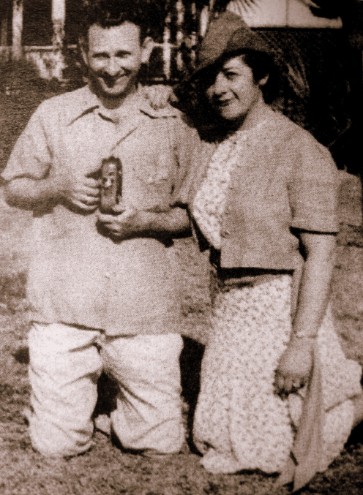
Tommy with his wife, Edith, 1936
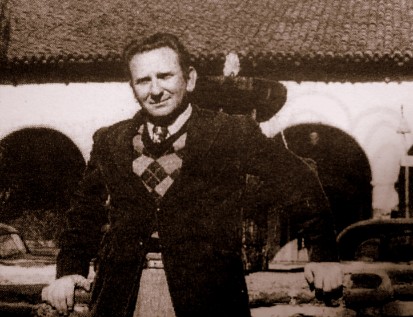
Tommy in 1946
Letter from Jeff Jennings
Nathan,
I saw your request for information about Tom Roberts on a website for
the Berkley Daily Planet. Tonight I was going through an old note
book that I kept while hitchhiking across the country in 1970 with a
friend. While reading it I came across a typed poem by Tom
Roberts, called ALCATRAZ! ALCATRAZ! The poem is about three and a
half pages in length and describes when several Native Americans
tried to reclaim the island on November 14th, 1969. It was most
likely typed by him and handed out on the street. We stayed in
Sausalito for a few days on a friends houseboat, and made a day trip
into San Francisco. My memory of the details are vague.
I decided to Google him and see if I could find anything on him.
That is how I found you. hope this helps.
The only other information is his address: Tom Roberts - The puppet man
1010 Bush Street ( rather ironic )
San Francisco
Phone # 673-5070
Good Luck!
Jeff Jennings

For an article concerning the Balmoral Residence Club Hotel at the address mentioned by Jeff Jennings go here:http://www.associatedcontent.com/article/337296/hotel_review_balmoral_residence_club.html?cat=16

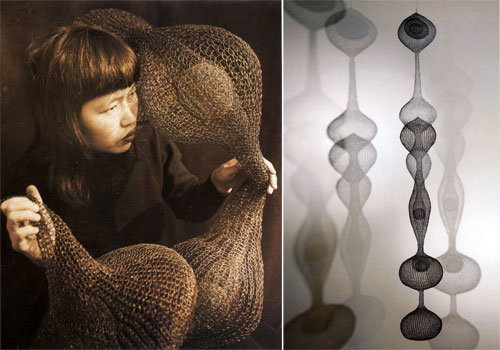
Here is a photo of Ruth Asawa, Japanese-American artist and educator, and one of her works. She created some of Tom Robert's puppets. Her photo is by Imogen Cunningham.
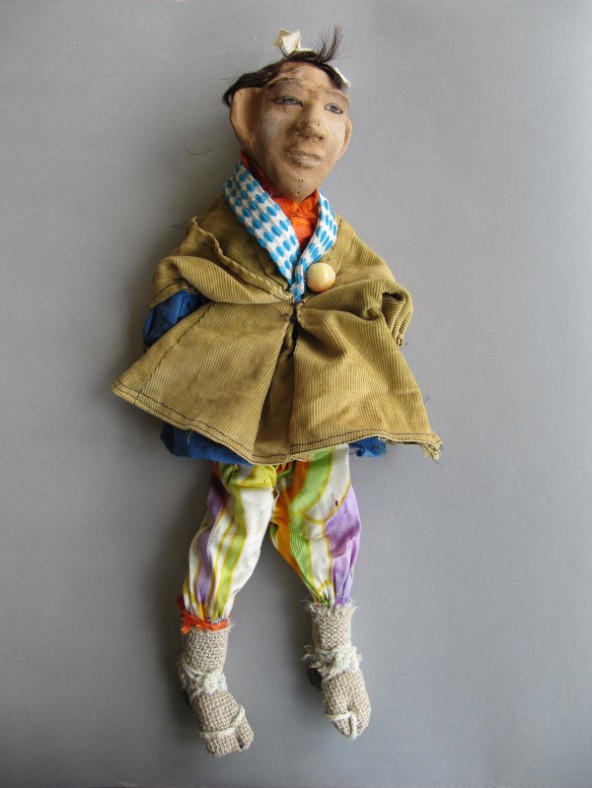
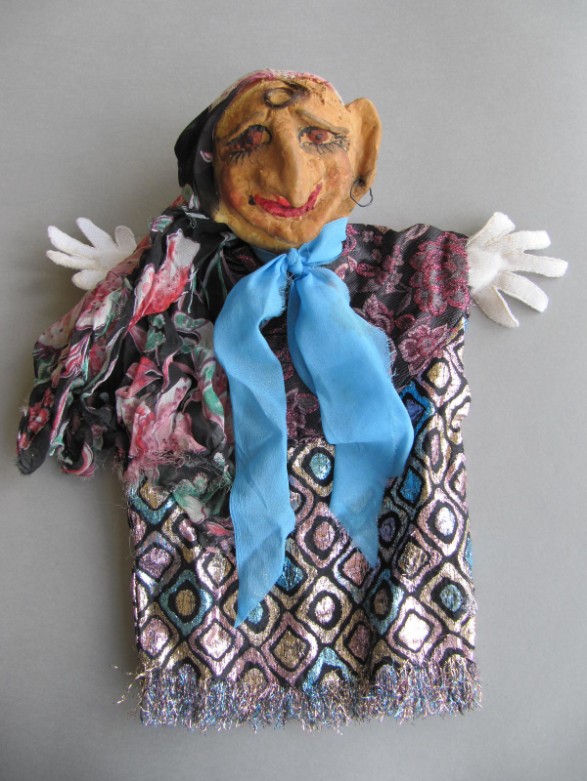
Below are some Tom-related puppets made by Ruth Asawa, with her daughter's words regarding them:
G
Email from Aiko:
I hope this is helpful.
Take care,
Aiko
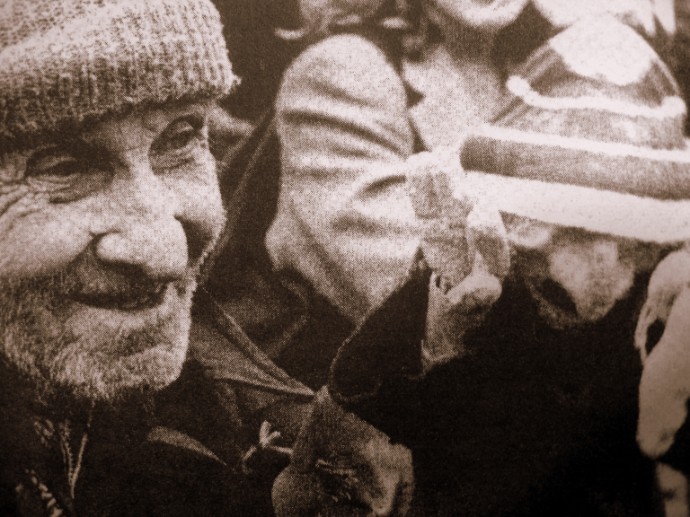
Tommy and his puppet, "Tomaso", designed by Ruth Asawa
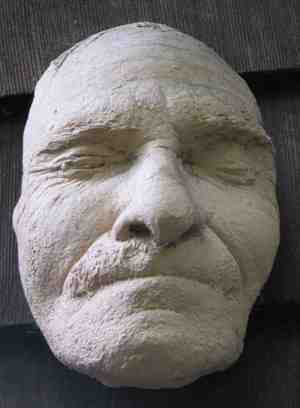
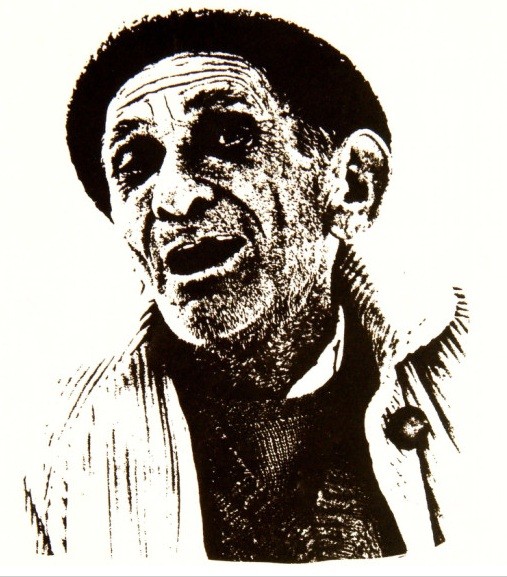
Aiko also provided this photograph of a life mask of Tom Roberts, made by Ruth.

Below: Cody's Books on Telegraph Avenue (closed 2006)
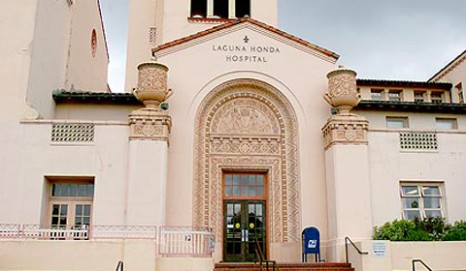
Here is a photo of Laguna Honda Hospital.
Letter from Sam Greyson:
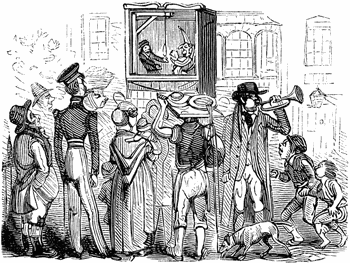
I recall the puppet man fondly from my early days in Berkeley (having arrived in early 1975). He used to have one of the puppets say,"Tommy wants to jump off the Golden Gate Bridge. Let's all yell DON'T JUMP, TOMMY!". The audience would shout "Don't jump, Tommy!" in unison. I seem to recall what I thought was a New York accent but that may be mistaken. He pulled his puppets out of a dirty paper bag. They seemed to me to be very rudimentary but his presentation and repartee were brilliant and highly engaging. He obviously was a man of some great intellect. I seem to recall him being hunched over as if he had spinal problems. He was a small man who wore ragged clothes. I've wondered many times over the years what became of him and greatly appreciate your efforts to keep him from being forgotten. Sam Greyson, Berkeley
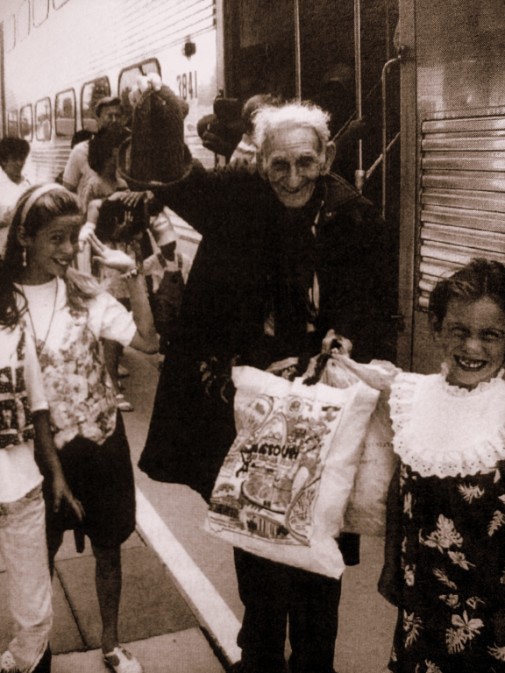
Tommy at Menlo Park train station after a Sunday with Judy and David Squier and their daughters (left to right) Betsy, Naphtalie, and Emily, 1990.
The following:
BANC MSS 81/10, Art, competence and citywide cooperation for San Francisco: Oral history transcript, Ruth Asawa
Excerpt
The Bancroft Library, University of California, Berkeley
Reprinted with permission (Friday, June 17, 2011)
Talespinners
Asawa: One of the most touching groups is the one with the
senior citizens. There's a group of artists; they're called Taleapinners.
They're actors. The nice thing about this is we were able to hire
senior citizens through CETA at half-time instead of full-time. We
had Tommy Roberts who is a puppeteer; he goes all over and he performs at
Cal Berkeley and other places.
Nathan: Oh, I've seen him.' He has a little knit cap, and he pulls the puppets out of his bag?
Asawa: Yes, right. And I made a puppet of him, a Tommy Roberts puppet.
[Laughter]
Nathan: Did you? A Tommy Roberts puppet.' Is it a hand puppet?
Asawa: It's a little hand puppet, and he uses it in his act all the time. In fact, I cast his face at one of the festivals, and I made some sketches while he was performing for us. He works with Talespinners and there's a group of about five actors.
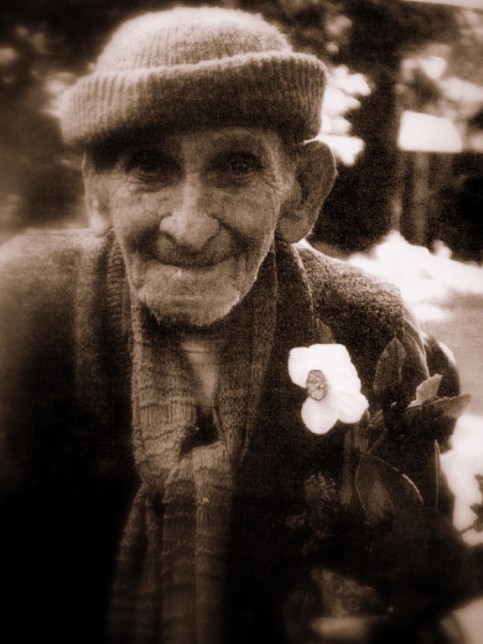
After touring Sunset Magazine's garden with Jean Lane and Judy Squier, 1994
Special thanks to Jed Diamond for his encouragement, emails and materials. It made this website much more informative and a special place for people to share and remember.
Mon 2016-10-10, 11:32 PM
Dear Person,
I hope you are well.
I was a student at UCSB in the early 1980’s and remember Tommy well. My friends and I would buy his poetry and a few puppets. He was a beloved part of the experience. After asking around, none of my friends were able to find a picture of him, either from their collections or on the internet. I did have several pictures of Tommy but they were lost in a house fire in ‘88.
We have a reunion every five years and I was hoping to bring a picture (or a print out of a picture) of Tommy to the next reunion. If you could kindly email any images you have that would be wonderful. We’ll print them out and put the on the memory table with some flowers.
Best Regards,
Chris Cunningham
Sun 2017-12-10, 7:14 PM
Hi Nat,
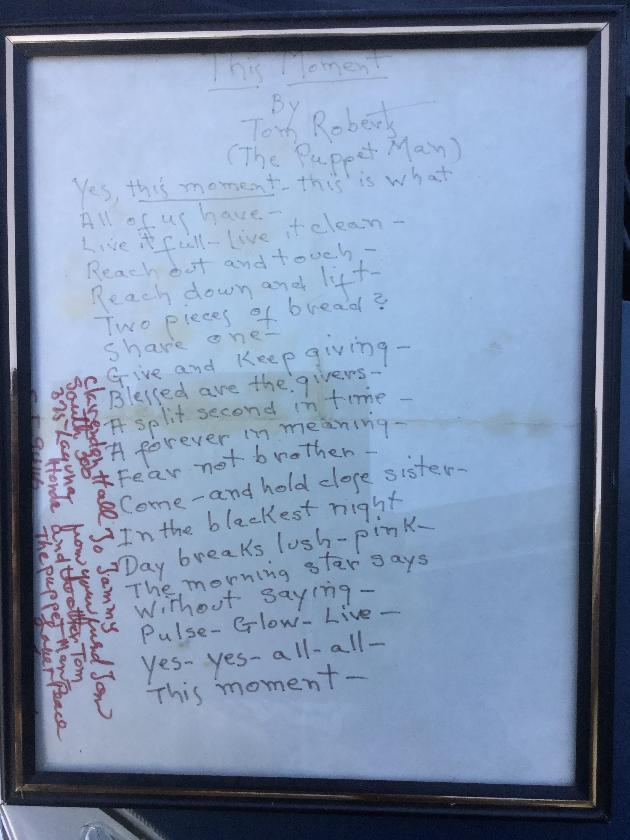
I came across your posting about Tommy the Puppet Man(8/28/2007) today. I have fond memories of Tommy from 35+ years ago when I was a student in Santa Barbara. Years later I came across him in San Francisco. Attached is a poem he signed for me. I hope this brings back fond memories for you and others who knew Tommy. I would love to see your photo of him.
Cheers,
Tom (...the other Tommy)
Make a free website with Yola
